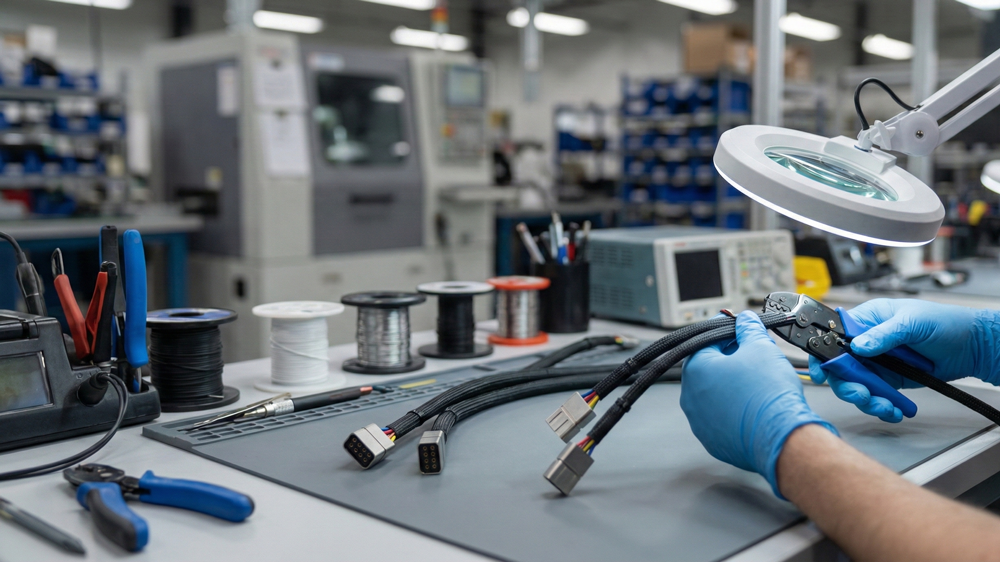
If you’ve ever had a harness shipment that “looked fine” but caused downtime, you already know the uncomfortable truth: most failures are not caused by one dramatic mistake. They come from small, repeatable gaps—misrouted branches, swapped connector IDs, marginal crimps, missing seals, wrong labels, mixed revisions, or packaging that damages connectors in transit. None of these issues are hard to prevent. They are hard to prevent consistently unless your wiring harness supplier operates with a clear, repeatable final inspection routine and you, as the OEM buyer, define acceptance in a way that can be executed.
This article gives you an OEM-ready wiring harness supplier checklist: what final inspection should include, how to structure acceptance rules, what test records matter, and how to avoid the most common “shipment surprises.” It’s written for B2B sourcing and engineering teams who want to reduce rework, shorten receiving inspection time, and stabilize field performance.
If you want a structured path to submit your RFQ and quality requirements together, use Custom Wiring Harness. If you want your acceptance language to map to verification evidence, anchor your expectations through Tests & Inspections and reinforce supplier accountability with Quality Guarantee and Quality Policy. For quality system proof points, reference Certificates.
Table of Contents
ToggleWhy a supplier checklist matters
Drawings define what to build. A checklist defines how you prevent drift. In practice, many harness issues occur not because the drawing is wrong, but because the last 5% of execution is inconsistent: the right parts are used but assembled in the wrong orientation; the right connector is used but pinned to the wrong cavity; the harness is electrically correct but mechanically fragile at the breakout; the correct variant is built but the wrong label is applied; the harness passes continuity but fails in vibration because strain relief was inconsistent.
Final inspection is the moment where these failure modes can be detected cheaply—before the harness leaves the factory. But final inspection only works when the supplier knows what “pass” means, when the inspection is repeatable, and when records are tied to the correct revision.
For OEM buyers, the goal is not to burden suppliers with bureaucracy. The goal is to create a common language: what must be checked, what must be recorded, and what requires approval when it changes.
The three layers of OEM-ready acceptance
A robust final inspection program usually has three layers: visual/build checks, functional tests, and documentation/revision control. If any layer is missing, you can still ship product—but you increase the chance that problems are discovered in your receiving dock or, worse, at your customer site.
Visual/build checks prevent workmanship and configuration errors. Functional tests prevent wiring mistakes and gross electrical faults. Documentation control prevents mixed builds and “unknown configuration” failures that are impossible to debug later.
The checklist below follows this logic. You can use it as-is, or adapt it to your program risk level.
Layer 1: Visual and build verification (what should be checked every time)
A good wiring harness supplier should perform a consistent visual/build verification on every unit, not just on samples. This verification should focus on items that create downstream failures even when continuity passes.
Start with connector-level checks. Confirm connector housings match the BOM and are correctly keyed and oriented. Confirm terminals are fully seated and locked. Confirm seals and cavity plugs are present where required and not damaged. Confirm backshells, boots, or strain relief components are installed correctly and do not interfere with mating.
Then move to wire and branch checks. Confirm branch routing matches the drawing intent. Confirm breakout points are within tolerance and protected as specified. Confirm the harness is not twisted in a way that will fight installation. Confirm protective materials—sleeves, conduit, tape, heat shrink—are applied in the correct locations and lengths.
Finally, confirm labeling and identification. If labels are part of your error prevention and traceability strategy, verify that connector IDs, branch IDs, destination text, and revision/variant codes are correct and readable. This connects naturally to your labeling-focused content and should be enforced as a real acceptance criterion, not an afterthought. You can reinforce this discipline through Quality Policy and by referencing your supplier’s evidence practices under Tests & Inspections.
This layer is also where “small” details cause big cost. A missing cavity plug might be a $0.02 part—but a field failure due to moisture ingress can cost thousands. The checklist keeps the economics honest.
Layer 2: Electrical verification (tests that prevent the most expensive mistakes)
For most harness assemblies, the baseline electrical verification should at least include continuity and shorts testing. In many OEM programs, pinout verification (correct mapping) is equally important, especially when connectors are similar or when harness variants share the same physical geometry.
Continuity and shorts tests reduce the risk of open circuits and unintended connections. Pinout verification reduces the risk of swapped wires and wrong cavity insertions—failures that can be catastrophic in power or sensor systems.
If the harness includes shielding, define how shielding termination is verified. If the harness is for control and automation systems, consider whether signal integrity or insulation resistance tests are required. The point is not to add tests for fun. The point is to align tests to risk and to ensure the supplier records test results in a way that ties back to revision and traceability.
For your public-facing evidence language, your best internal anchor is Tests & Inspections. Buyers reading your site should see that your verification claims map to actual recorded checks.
Layer 3: Records, revision control, and “what changed” discipline
Many B2B harness problems become painful not because the harness failed, but because nobody can prove what was shipped. Mixed revisions, undocumented substitutions, and unclear lot separation turn troubleshooting into guessing.
An OEM-ready supplier should tie each shipment to a build revision and—when required—to a traceability scheme (lot or serial). They should also be able to show that no substitutions occurred without approval.
This is where your earlier BOM discipline becomes operational. If your BOM defines terminal part numbers and wire construction, the supplier must build exactly to those inputs or ask for approval. If the supplier can change inputs silently, your inspection and test results become less meaningful.
A mature final inspection package often includes: a reference to BOM and drawing revision, test results records, and a clear labeling/traceability summary. It doesn’t need to be complex. It needs to be consistent.
The OEM-ready final inspection checklist (supplier-facing)
Below is a checklist you can provide to a wiring harness supplier and also use internally during receiving inspection. Keep it short enough that it will be executed, but complete enough to prevent predictable failures.
A) Configuration and BOM alignment
Confirm harness part number and revision match order and build documents.
Confirm connector housings, terminals, seals, cavity plugs match BOM.
Confirm wire gauge and construction match BOM intent (not just color).
Confirm any approved alternates are documented and explicitly approved.
B) Connector and termination workmanship
Confirm terminals are fully seated and locked; no back-out.
Confirm conductor crimp and insulation support are present and consistent.
Confirm no exposed conductor outside allowed limits; no strand damage visible.
Confirm seal integrity and correct seal-to-wire OD fit where applicable.
Confirm strain relief boots/backshells installed correctly and do not interfere with mating.
C) Harness geometry and mechanical protection
Confirm branch lengths and breakout positions are within tolerance.
Confirm breakout protection is applied as specified; no sharp stiffness transitions.
Confirm sleeving/tape/conduit/heat shrink applied in correct zones and lengths.
Confirm harness lay is neutral (no excessive twist) and installation-friendly.
D) Labeling, identification, and variant control
Confirm connector IDs and branch IDs match drawing/circuit list.
Confirm destination text and orientation is readable in installed state.
Confirm revision/variant code is present and correct.
Confirm serial/lot codes (if required) are present and match shipment records.
E) Electrical verification
Perform continuity and shorts testing across all circuits.
Perform pinout/mapping verification to prevent swapped cavities.
Verify shielding termination continuity/grounding where applicable.
Record test results and link to revision and traceability ID.
F) Packaging and shipping protection
Protect connectors and pins from impact and contamination.
Prevent branch tangling and abrasion; package to match install sequence when possible.
Separate variants/revisions physically; label outer packaging clearly.
Include packing list with revision, quantity, and traceability summary.
This checklist is intentionally structured so the supplier can execute it with minimal interpretation. If your supplier’s process is mature, they can map these checks to their internal work instructions and inspection forms.
How to set acceptance rules so suppliers don’t “pass by interpretation”
Checklists fail when suppliers can interpret acceptance differently. To avoid that, define a few simple acceptance rules in writing.
First, define “build to revision.” The supplier must build to the referenced BOM/drawing revision, and any changes require approval. Second, define “no substitutions without written approval.” Third, define required records: test results must be recorded and associated with the shipment and revision.
If you want to go one step further without making it complex, define a short first-article requirement: the first shipment includes enhanced evidence—photos of critical areas, pull test summaries if agreed, and microsection evidence for high-risk terminations when required. This pairs naturally with your previous microsection article and creates a cohesive qualification framework.
Common failure modes this checklist prevents (and why it saves money)
The checklist prevents a small set of high-cost failure modes: wrong cavity insertions, missing seals, back-out terminals, inconsistent strain relief, wrong variant shipments, and shipping damage. These are expensive because they create rework and downtime, not because the parts are expensive.
If your harness is used in automation, robotics, or control systems, the payoff is even larger because downtime is costly and diagnosing intermittent issues is slow. Linking your content and qualification narrative to Industrial & Robotics and Control Wire Harness helps buyers see that this checklist is grounded in real field economics.
FAQ
What should an OEM include in a wiring harness supplier checklist?
Include configuration/BOM checks, connector and termination workmanship, harness geometry and protection, labeling/variant control, electrical tests (continuity + mapping), and packaging protection with records.
Is continuity testing enough for harness acceptance?
Continuity reduces open-circuit risk, but pinout/mapping verification prevents swapped cavities, which can be more damaging. Many OEM programs require both.
How do we prevent mixed revisions from a harness supplier?
Require build-to-revision discipline, no substitutions without approval, and traceability labeling that ties shipments to revision and test records.
What records should a harness supplier provide?
At minimum, reference to BOM/drawing revision and recorded test results. For higher-risk programs, add traceability (lot/serial) and first-article evidence.
How should harnesses be packaged to prevent shipping damage?
Protect connectors/pins, prevent tangling and abrasion, separate variants, and label packaging clearly. Kitting to install sequence reduces errors.
CTA: Make harness acceptance repeatable—before product leaves the factory
If you want stable deliveries from a wiring harness supplier, don’t leave final inspection to “common sense.” Define a short, executable checklist and require records that tie tests to revision and traceability. That approach reduces receiving-time inspection, prevents field mix-ups, and makes troubleshooting faster when issues arise.
To request a quote with clear acceptance requirements, submit your BOM + drawing + circuit list through Custom Wiring Harness. If you want an engineering review first—final inspection scope, test strategy, labeling/packaging rules—reach out via Contact. We’ll align your checklist to verifiable evidence using Tests & Inspections and your quality commitments.