When buyers say they “have a wire harness drawing,” they often mean a screenshot from CAD, a schematic export, or a layout that looks like a harness. Manufacturers mean something stricter: a build definition that tells an operator exactly what to build, how to measure it, and how to verify it—without guessing, without “tribal knowledge,” and without an email thread full of clarifications.
If you’re sourcing custom harnesses, this difference matters more than almost anything else you can send in an RFQ. A manufacturable harness print is the fastest path to stable quotes, predictable lead times, fewer prototype surprises, and consistent production quality. Without it, you will still get a quote—but it will be a quote built on assumptions, and assumptions are where cost drift and quality escapes begin.
This guide is written for practical B2B sourcing. It focuses on what a factory needs to build correctly and repeatably, not just what an engineer needs to understand electrically. If you want a structured path to submit your package, start with Custom Wiring Harness. If you’re comparing whether your build is more “harness” or “cable assembly,” use Wiring Harness and Cable Assemblies as quick reference hubs.
Table of Contents
ToggleWhy wire harness drawings fail (and why projects slip)
Most harness drawing failures are not dramatic. They don’t look like “wrong information.” They look like missing rules. A branch length is shown, but nobody defined from where to where. A breakout is drawn, but its location is implied rather than dimensioned. A connector is listed, but the drawing doesn’t clarify whether the view is from the mating face or the wire-entry side. A note says “100% test,” but it doesn’t specify whether “test” means continuity only or a full pin map.
In prototype builds, a strong supplier can often “figure it out” with back-and-forth. In production, that same ambiguity becomes variation: two operators interpret the same print differently, or one shift measures length differently than another. That’s how you get harnesses that pass basic continuity but fail fitment, service loops that are too short, branches that exit at the wrong place, and intermittent failures caused by strain relief being treated as optional.
A good manufacturable print eliminates interpretation by being explicit about four things: interface, geometry, materials, and verification. The rest of this article shows how to lock those four pillars into a drawing package that manufacturers can execute.
What a “manufacturable harness print” includes
You don’t need a 30-page drawing set to be manufacturable. You need completeness in the right places.
A typical quote-ready, build-ready harness package includes:
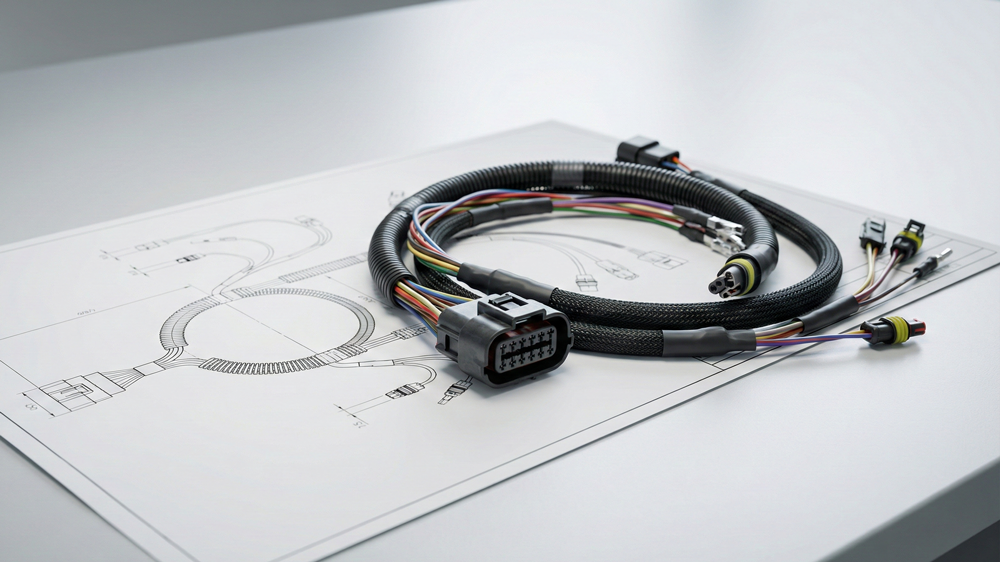
- A harness drawing (physical layout) that defines lengths, breakouts, branch identification, and measurement rules.
- A connector/pinout definition that is unambiguous and cross-referenced to the drawing.
- A BOM (or at least a bill of materials list) that locks part numbers for connectors/terminals/seals and defines wire and protection specs.
- A notes block that defines workmanship intent and test requirements.
If you’re working with a supplier that offers engineering support, this is where their value shows up: they’ll help you close gaps without changing your intent. That’s what Strong Technical Support should feel like in practice, not as a marketing line.
Step 1: Define length the way you will measure it
Length is the #1 source of hidden ambiguity in harness drawings. Two organizations can build the same harness and both claim they met the drawing—because the drawing never defined how length is measured.
The rule: every length needs a measurement method
For each trunk length and each branch length, define the measurement method in words. Don’t rely on the drawing alone to imply it. A short note that removes interpretation can save multiple iterations.
A few examples of measurement definitions that manufacturers can follow:
- “Length measured from connector mating face to mating face, along cable centerline.”
- “Branch length measured from breakout point to connector mating face, along cable centerline.”
- “Breakout location measured from Connector J1 mating face to breakout center, along trunk centerline.”
You don’t have to use this exact wording, but you do have to define start point, end point, and path. Without those three, length is a debate.
Connector reference points: pick one and stick with it
Connectors can be measured from the mating face, the back of the housing, or the wire-entry plane. Different teams default to different points. If you never define the reference point, you’ll see a consistent “off by X mm” problem that is not really a manufacturing defect—it’s a documentation defect.
A practical sourcing approach is to standardize on “mating face” as the default reference point unless there is a reason not to. The point is consistency, not ideology.
Step 2: Make breakouts explicit (breakouts are manufacturing operations)
A breakout is where a trunk splits into branches. In your product, breakouts are about routing and clearance. In manufacturing, breakouts are about controlling geometry, strain relief, wrapping method, and repeatability. If breakouts are not dimensioned, branch location will drift—especially when operators are working fast or when harnesses are built without a dedicated board.
What to define for a breakout
If the breakout position affects fitment or strain, define it with at least one dimension. If the breakout needs a specific “window” of variation, define the tolerance or acceptable range.
Breakouts also interact with protection materials. If you use braided sleeving, corrugated conduit, tapes, or heat shrink transitions, specify where those start/stop relative to the breakout. If you expect a boot or overmold at a breakout, make that intent clear early, because it changes tooling and process planning—this is where Overmolding Services becomes relevant even during “drawing” discussions.
Step 3: Connector views, pin numbering, and orientation—no guessing allowed
A harness can be electrically correct and still fail integration because a connector is rotated, mirrored, or interpreted from the wrong face. The risk increases when connectors are similar, when there are multiple branches, or when the harness includes mirrored left/right variants.
Always label the connector view
If you show a pinout diagram or connector face, explicitly label whether it is:
- Mating face view
- Wire-entry view
This one line prevents a surprising number of pin mapping mistakes.
Orientation matters: keying, latch, and clocking
If connector orientation or clocking affects assembly or installation, show it. A simple “latch up” note, or a small connector sketch with an arrow, often prevents first-article failures. If you have multiple connectors of the same family, include a unique identifier on the drawing and make sure it matches the pinout and BOM.
If your harness is used in industrial control or sensor systems, connector mapping errors can cause intermittent behavior that looks like software or EMI trouble. Buyers in these categories often search for disciplined build processes and verification—linking to Tests & Inspections can help set expectations that pin mapping is treated seriously rather than as an afterthought.
Step 4: Cross-reference the drawing to a BOM (or it will be re-quoted later)
A manufacturable harness drawing is not a standalone artifact. The drawing must connect to a BOM that locks materials. Otherwise, your supplier has to guess terminals, seals, wire spec, and protection materials. That guess becomes the quote. When you clarify later, the quote changes.
What belongs in the drawing vs the BOM
The drawing is ideal for geometry and assembly intent: lengths, breakouts, branch IDs, wrap start/stop points, and notes about strain relief, routing intent, and labeling placement.
The BOM should lock part numbers and specs: connector housings, terminals, seals, wire construction (gauge + insulation), protective materials, labels, clips/grommets, and any special consumables that affect build.
If your team is still stabilizing materials, you can use a “preferred + approved alternate” approach. If you do, be explicit that substitutions require approval. Silent substitutions are one of the most common root causes behind “the harness is the same but behaves differently.”
For material terminology consistency, anchor your language to Cable Wiring Materials so your organization and your suppliers don’t interpret “braid,” “sleeve,” “tape,” or “heat shrink transition” differently from project to project.
Step 5: Tolerances—tight where it matters, flexible where it doesn’t
Harness tolerances are not only about precision. They are about cost, lead time, and variation control. Tight tolerances increase scrap and rework. Loose tolerances can break fitment. A good harness print communicates what matters.
If a branch must land exactly to reach a connector without stress, tighten that branch’s tolerance. If a trunk has service loop slack and the exact length does not affect installation, allow broader tolerance. Manufacturers can build tighter, but it will cost more and it will slow down.
When you don’t specify tolerances, suppliers will assume defaults. Different suppliers assume different defaults. That is why two quotes for “the same drawing” can differ more than you expect.
Step 6: Add a notes block that converts intent into build rules
Many teams underestimate how powerful a good notes block is. Your drawing might be visually clear, but your notes block is what makes it repeatable and auditable—especially when new operators or new shifts are involved.
A practical notes block usually covers:
- Measurement rules (length definitions and reference points)
- Workmanship intent (how to handle breakouts, wrapping, strain relief)
- Labeling and kitting expectations
- Test expectations and acceptance criteria
- Packaging / protection requirements for shipping
This is also where E-E-A-T becomes real: a buyer reading your content wants to see process discipline, not just claims. Linking your notes and verification language to quality pages such as Quality Guarantee and Quality Policy builds trust because it shows you treat “quality” as a system.
A manufacturable harness drawing notes template (copy/paste starter)
Below is a manufacturer-friendly starter you can adapt. Keep it short, but explicit.
Measurement & geometry
Lengths measured along cable centerline. Connector reference point = mating face unless otherwise specified. Breakout location measured from J1 mating face to breakout center along trunk centerline.
Materials & alternates
Build per BOM revision X. No material substitutions without written approval. Wire spec per BOM (gauge + insulation type).
Workmanship
Breakouts to include strain relief; wrap transitions to be smooth with no exposed conductor; no sharp bends at connector exits. Protection starts/stops per drawing callouts.
Labeling & kitting
Labels per drawing: content, placement, durability requirements. Harness to be kitted by assembly variant and revision.
Testing & inspection
100% continuity + short test. Pin mapping verification per circuit list. Record results per lot (or per serial number if required). For additional verification options see Tests & Inspections.
Packaging
Protect connectors and pins from damage. Coil and tie to avoid kinks. Packaging must prevent abrasion during transit.
If you want a supplier that can align quickly on these rules and scale them, you’ll also want to see how they describe capability and flexibility—pages like Assembly Capabilities and Flexible Manufacturing are where good suppliers usually document those systems.
Step 7: Add a “drawing checklist” that is short but complete
This is the one place where a small checklist is worth it. The goal is not bureaucracy. The goal is to prevent the 5–10 missing details that cause 80% of quote delays.
Wire harness drawing checklist (manufacturer-facing)
- Each connector has a unique ID (J1, J2…) and the view is labeled (mating vs wire-entry).
- Each branch has an ID (B1, B2…) and a defined length measurement rule.
- Each breakout has an explicit location definition (dimension or reference).
- Protection materials have start/stop callouts (sleeve/tape/conduit/heat shrink).
- Strain relief intent is defined at critical interfaces.
- Drawing references BOM revision and circuit list/pinout revision.
- Test requirement is stated (continuity + pin map at minimum).
- Labeling placement is shown where it matters (variant control/service).
- Packaging requirement is stated if connectors/pins are sensitive.
If your goal is speed, pair this checklist with a structured RFQ submission via Custom Wiring Harness and include the drawing + BOM + circuit list as one bundle. If you need rapid turnaround builds, align expectations through Quick Turn Available before you press for aggressive lead times.
Common “looks fine” drawing mistakes that cost weeks
A frequent mistake is a drawing that shows branch lengths but never defines where the breakout begins. Another is a connector face diagram that doesn’t label the view, which creates a pin numbering mismatch. Another is assuming “wire colors” are enough, when the program actually needs wire IDs and a circuit list that can be verified in a pin mapping test.
Sometimes the biggest mistake is simply omitting the environment. If the harness will see vibration, abrasion, fluids, or repeated motion, your drawing needs to reflect the mechanical reality through protection and strain relief rules. If your harness is used in industrial systems, it often helps to align vocabulary with pages like Control Wire Harness or Control Cable Assemblies so readers (and suppliers) immediately understand the application class.
FAQ
What is the difference between a schematic and a wire harness drawing?
A schematic defines electrical connectivity. A harness drawing defines the physical build: lengths, breakouts, branch geometry, assembly intent, and measurement rules so production is repeatable.
How do we define wire harness length so the factory measures it the same way we do?
Define the measurement method in words: start point, end point, and path (e.g., mating face to breakout along centerline). Without those, length is open to interpretation.
Do we need breakout dimensions on every harness?
If a breakout affects fitment, strain, routing, or serviceability, dimension it or define an acceptable window. If it’s non-critical, you can allow flexibility to reduce cost.
Should the drawing include BOM part numbers?
You can include key part numbers, but the safest approach is to cross-reference a BOM revision and keep part numbers controlled there. The key is avoiding silent assumptions.
Is continuity testing enough?
Continuity is necessary, but pin mapping verification is what reduces miswire risk. Align test requirements to your risk profile and document them clearly; reference Tests & Inspections for verification language.