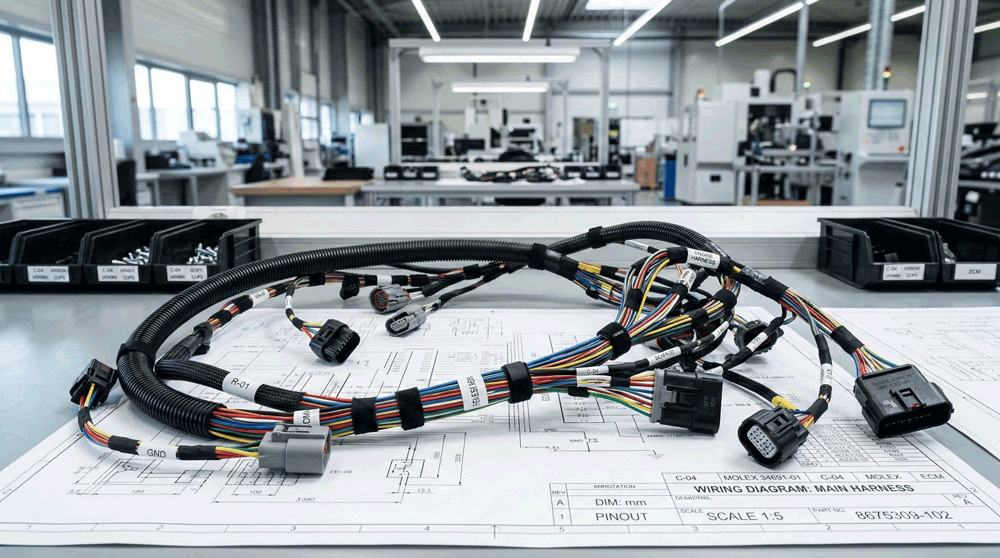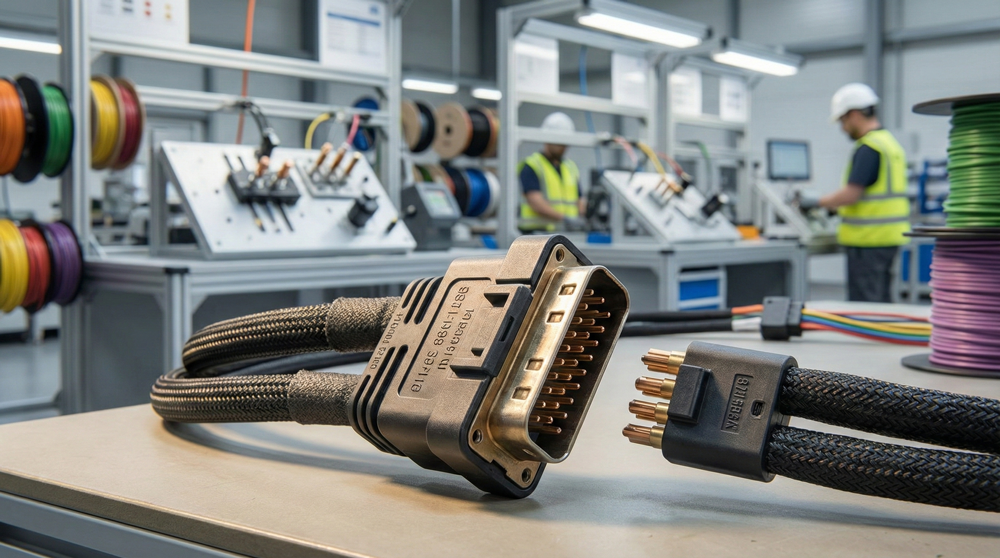
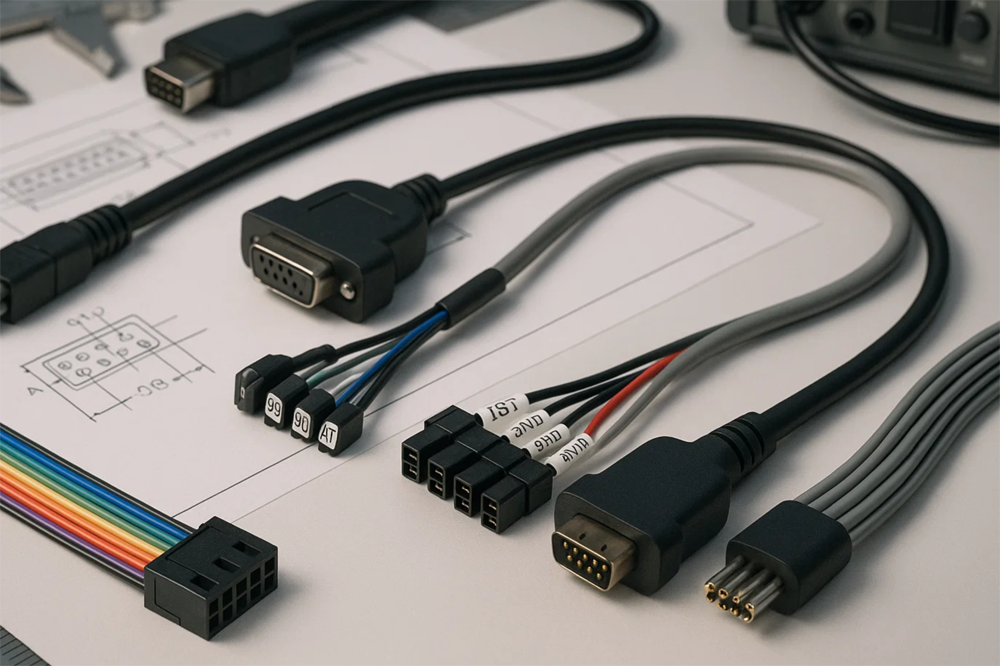
Overmolding is one of those manufacturing terms that gets used casually—until a project fails in the field. In a quote request, “overmolded cable assembly” can sound like a cosmetic preference. In real applications, cable overmolding is usually a functional design decision: it’s how you control strain relief, sealing, abrasion resistance, and long-term durability at the connector transition—the exact location where cables most commonly crack, wick moisture, or fail under vibration and flex.
This guide is written for B2B engineers and sourcing teams who want overmolding to do what it’s supposed to do—without adding unnecessary cost, lead-time surprises, or tooling rework. We’ll cover what overmolding is (in manufacturing terms), when it’s worth the complexity, how to select materials, and how to design for manufacturability so the first molds don’t become the first failure point. If you’re evaluating suppliers, you can also cross-reference the capability framework in Cable Assemblies and the dedicated scope page Overmolding Services. If you already have drawings and want a quote, the fastest path is Custom Cable Assemblies.
Table of Contents
ToggleWhat “cable overmolding” actually means (and what it does not mean)
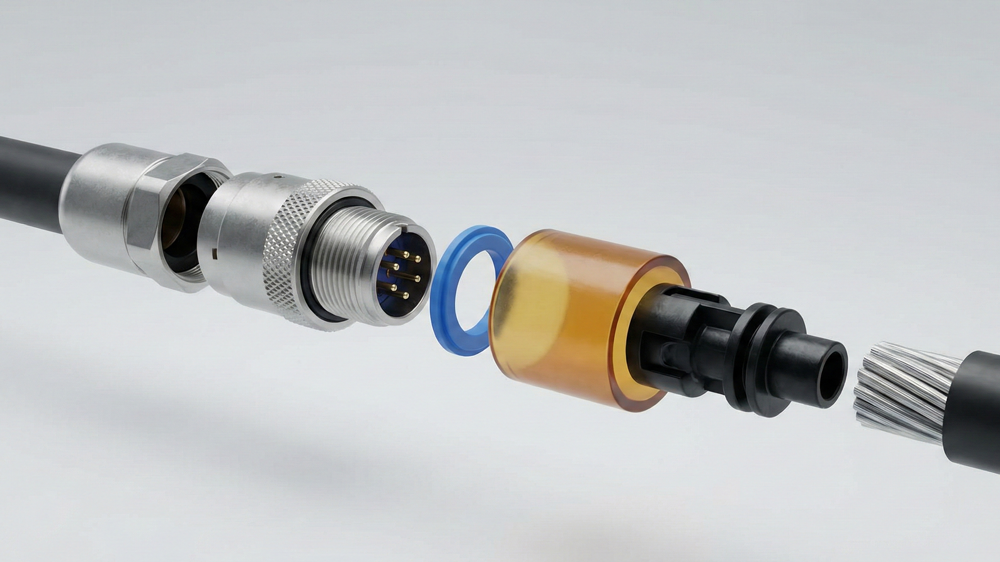
Overmolding is the process of injecting a polymer around an existing subassembly—typically a cable and connector interface—to create an integrated protective feature. The overmold can function as strain relief, sealing, a grip feature, a routing feature, or a protective boot. It often replaces multiple parts and manual operations (separate boots, heat-shrink transitions, adhesive wraps), but it also introduces tooling and DFM constraints that you must treat as part of the product design.
What overmolding does not automatically guarantee is “IP sealing” or “unbreakable strain relief.” Those outcomes depend on geometry, material choice, jacket preparation, and how the overmold interfaces with the connector body and cable jacket. Many field failures happen because overmolding was treated as a post-processing step rather than a design feature with defined performance targets.
If you’re sourcing an overmolded build, the best mental model is simple: overmolding is a mechanical system with a materials interface. You must define both.
When overmolding is worth it (and when it’s not)
Overmolding is typically worth the added complexity when your risk is not “does the cable conduct electricity,” but “does the cable survive real use.” If your product experiences any of the following, overmolding often pays for itself by reducing returns and field failures.
If the cable will see repetitive bending at the connector exit—such as handheld devices, robots with cable carriers, sensor leads, motion systems, or frequent plug/unplug cycles—strain relief becomes the dominant reliability variable. A properly designed overmold can spread bending stress over a longer distance and reduce the chance of conductor fatigue, jacket cracking, or intermittent failures.
If the cable is exposed to moisture, washdown, condensation, or chemicals, overmolding can help reduce ingress paths—especially at the connector transition and jacket cutback area. But sealing only works when the interface is designed to block wicking and micro-gaps, and when the material bonds or mechanically locks to the substrate.
If your build needs a clean, repeatable, professional finish—especially for OEM products where appearance is part of brand quality—overmolding can deliver consistent geometry and reduce manual finishing variability.
Overmolding is usually not worth it when volumes are extremely low, the cable is static and protected, and the failure risk is already acceptable. In those cases, simpler alternatives—high-quality heat-shrink boots, clamp-based strain relief, or potting plus boot—can often meet the functional requirement with far less tooling cost and less lead-time risk. A mature manufacturer should be able to discuss these alternatives candidly under Strong Technical Support, because “overmold everything” is not a serious engineering approach.
Materials: what really drives overmold performance
Material selection is where many projects become expensive, because buyers choose materials based on generic labels rather than interface behavior and service conditions. In overmolding, you don’t only select a polymer. You select an interface strategy.
TPU vs TPE (and why the label isn’t enough)
TPU and TPE are both common overmold materials because they can provide toughness, flexibility, and abrasion resistance. The practical difference in sourcing is that each family includes many grades with different hardness, temperature range, and bonding behavior. Your choice should be guided by the function you need.
If you need a strong flexible strain relief that resists tearing and abrasion, a TPU-type overmold often becomes a candidate because it can maintain toughness under repeated flex. If you need a softer grip or a more rubber-like feel, certain TPE grades may be considered.
But the bigger decision is not “TPU vs TPE.” It’s “does this material bond well (chemically or mechanically) to the cable jacket and connector body, and will it remain stable in the environment?” If you don’t define the environment—oil, UV, cleaning chemicals, temperature cycling—material selection becomes guesswork.
Your cable jacket material matters too. Overmolding onto PVC, PUR, TPE, or other jackets can behave very differently. Some combinations rely on adhesion; some require mechanical interlocks; some need primers; some will never bond reliably and must be designed as a purely mechanical capture. That’s why your RFQ should always specify the cable jacket type and, if available, the cable datasheet. If you’re not sure what to include, start with the materials framing in Cable Wiring Materials.
Mechanical lock vs adhesion (choose consciously)
A common mistake is assuming adhesion will solve everything. In reality, adhesion can be excellent or unreliable depending on material pairing and surface conditions. The safer mindset is: use mechanical retention features as the primary strategy, and treat adhesion as a bonus when it’s available and stable.
A mechanically retained overmold typically uses geometry—undercuts, grooves, connector features, cable jacket steps, or knurling—to prevent pull-out and prevent rotation, even if chemical bonding is weak. This is often the most robust approach across suppliers, because it reduces dependence on perfect surface preparation.
When you evaluate a supplier, ask whether their design approach relies on adhesion, mechanical interlocks, or both. A serious overmolding supplier will be able to discuss how they prevent connector pull-out and how they control repeatability—not only “we use good material.”
DFM: designing overmolded cable assemblies that can be manufactured reliably
Overmolding failures are frequently DFM failures. The design looks good in CAD but cannot be molded consistently, or it can be molded but does not perform under bending, pulling, or ingress conditions. This section gives you the DFM logic to prevent both outcomes.
Define the functional goal first (strain relief, sealing, abrasion, grip)
Overmold design begins with one question: what is the primary function? A strain relief overmold should be shaped to distribute bending stress gradually, not to look “thick.” A sealing overmold should be designed to block ingress paths, not only to cover a region. A grip overmold should be shaped for handling and should avoid creating stress risers at the cable exit.
If you don’t state the primary function, suppliers will default to whatever they’ve done before, which may not match your use case.
Cable exit geometry is the strain relief “engine”
For strain relief, the cable exit region is critical. Sharp transitions concentrate bending stress. A well-designed overmold creates a gradual taper and avoids sharp corners at the point where the cable exits the mold. The goal is to reduce the bending strain per unit length at the highest-risk location.
In practice, that means you want the cable to exit along a controlled bend path, with enough overmold length to spread the stress. If your application has a tight bend radius constraint, you must state it. If the cable will be clamped or routed immediately after exit, you must state that too, because it changes how strain relief should be designed.
Wall thickness, draft, and parting lines still matter—even for “soft” parts
Overmolded features are often flexible, but they still require molding discipline. Extremely thick sections can cause sinks, voids, and inconsistent fill. Very thin sections can tear or fail in molding. Draft angles are needed for release unless you deliberately design features that require special tooling strategies.
Parting line placement matters for both appearance and function. If the parting line intersects a sealing interface, you can create a micro-path for ingress. If it intersects a grip area, you may create an uncomfortable seam or a tear initiation line.
A supplier who understands DFM will not only accept your CAD; they will also advise where parting lines and gates should go for consistent results.
Gating and venting can decide whether the overmold is “good” or “random”
Overmolding involves filling polymer around complex shapes—connector bodies, cable jacket steps, sometimes braid terminations. Gate location affects flow direction and can influence weld lines and weak zones. Venting affects whether air traps create voids. These are manufacturing realities that should not be “invisible” to the buyer.
You don’t need to be a tooling engineer to manage this risk. You simply need to work with a supplier who makes gating and venting part of the engineering discussion—and who can show they’ve solved it before.
Surface preparation: don’t assume it’s “standard”
If your strategy depends on adhesion, surface prep becomes a controlled process. That might include cleaning, abrasion, priming, or other treatments. If it’s not defined, it will vary, and your bond quality will vary. Even if you use mechanical retention, surface prep can still matter for preventing wicking paths and ensuring stable capture.
This is another reason to qualify suppliers on process control. You can benchmark their discipline via Tests & Inspections and Quality Policy.
Overmolding plus shielding: what changes when the cable is shielded
Overmolding around shielded cable assemblies introduces extra considerations because the termination zone is more complex. Shielding systems often include braid, foil, drain wires, and connector backshell or shielding termination features. Overmolding must not compromise the electrical shield path, and it must not create mechanical stress that damages braid or drain connections.
A common sourcing trap is overmolding a shielded cable “for strain relief” but unintentionally creating a failure risk by trapping stress at the shield termination zone. The right approach is to treat shield termination and strain relief as a single design system. If you’re sourcing a shielded build, it’s useful to align expectations with the scope described in Shielded Cable Assemblies and then explicitly state how shielding is terminated and what “pass” criteria are expected.
If the product is RF/coax, the risk increases because geometry changes can influence performance. Overmolding is still possible, but you want a supplier who treats the termination as controlled and who can explain how they avoid damaging the coax structure. That’s why, in the broader cluster, your upcoming S7 is important—but even in overmolding, the principle holds: performance-sensitive cables require higher discipline.
Prototyping vs production: how to avoid tooling surprises
Overmolding can be done in a prototype-friendly way or a production-optimized way. The mistake is treating them as the same.
For very low volume, you may choose simplified overmolding options or alternative strain relief solutions to avoid paying for full tooling before the design stabilizes. Some programs begin with a non-molded boot solution, validate geometry and routing, then transition to overmolding when the design is stable. This staged approach can reduce engineering churn and prevent paying for mold rework.
Once you move toward production, tooling decisions become important. Tool material, expected life, cavity count, and cycle time will impact unit cost and lead time. A manufacturer who can discuss these factors clearly is demonstrating real capability, not just “yes we can overmold.”
If your program timeline is aggressive, you should also align on quick-turn feasibility. Not every overmolded design can be rushed without risk, because tooling and material lead times exist. If quick-turn is a requirement, anchor expectations through Quick Turn Available and confirm what can be accelerated and what cannot.
What to specify in an RFQ for overmolded cable assemblies (so quotes don’t drift)
Overmolding quotes drift when the RFQ is vague. Suppliers fill gaps with assumptions, and those assumptions change later. If you want stable quotes, specify the elements that actually control performance and cost.
At minimum, your RFQ should describe the cable type and jacket material, the connector part numbers, the target overmold function (strain relief, sealing, grip), and any environmental conditions. If you have a target IP level, state it as a requirement and define how you intend to validate it. If you need appearance control (color, texture, logo, marking), specify it up front because it affects material selection and tooling.
The best RFQ packs also include a drawing or 3D model of the overmold geometry, even if it’s a preliminary concept. If you don’t have CAD, a manufacturer with strong engineering support can help you translate functional requirements into a manufacturable overmold geometry—but you should treat that as an engineering activity, not a free “quote step.” This is where Strong Technical Support becomes a real differentiator.
If you want a structured intake path designed specifically for cable builds, use Custom Cable Assemblies. That route reduces “missing information loops” and speeds up quoting.
Validation and tests: how to define “pass” in a way that matches real use
Overmolding often fails mechanically, not electrically. If your acceptance criteria only say “continuity test,” you may ship parts that pass today and fail after weeks of flex.
A practical validation plan depends on the product, but you can define “pass” in operational terms that align with your use case. If the risk is cable pull-out, define a pull test requirement. If the risk is repeated bending, define a bend test profile (cycles, radius, load, direction). If the risk is moisture ingress, define a sealing test expectation. If the risk is abrasion, define abrasion exposure conditions.
You don’t need to publish your internal test standards publicly, but you do want your supplier to understand them and to build process controls that support them. From a buyer trust perspective, a visible testing system like Tests & Inspections helps demonstrate that testing is a controlled deliverable. From a manufacturing discipline perspective, quality pages such as Quality Guarantee and Certificates support stakeholder confidence—especially when sourcing overseas.
Common overmolding problems (and how to prevent them before they happen)
Most overmolding failures fall into a few patterns.
One pattern is pull-out or rotation because the design assumed adhesion that wasn’t stable, or because the geometry didn’t include mechanical retention. Preventing this usually means designing capture features and verifying pull-out performance early.
Another pattern is cracking at the cable exit because the overmold created a sharp stress riser or because the cable was forced into an unrealistic bend path in real installation. Preventing this means designing a gradual taper and validating bend conditions that match real use.
Another pattern is voids or incomplete fill caused by gating, venting, or wall thickness design issues. Preventing this means treating DFM as part of the design and working with a supplier who can discuss mold strategy transparently.
A fourth pattern is leakage/ingress because the design didn’t address micro-gaps at the interface or because parting lines were placed in a sealing-critical location. Preventing this means designing sealing features intentionally and validating sealing performance rather than assuming “covered equals sealed.”
If you only remember one lesson, remember this: overmolding is not a decorative cap. It’s a functional interface that must be designed and validated.
CTA: get an overmolded cable assembly that survives real use
If your product needs strain relief, sealing, or long-life durability at the connector transition, overmolding can be a high-leverage solution—when it’s designed with the right materials and DFM discipline.
If you want to discuss feasibility, material choice, and a DFM-first approach before finalizing geometry, start with Overmolding Services or reach out through Contact. If you’re ready to quote, submit your RFQ via Custom Cable Assemblies and include cable spec, connector part numbers, overmold function, environment, and any validation requirements you care about.